The engine air filter is the cheapest part on a Mercedes-Benz that can quietly cost you the most: every litre of air the engine burns passes through it, and once the paper is loaded with dust the engine works harder for less. It is also a job most owners can do at home with a Torx driver. Here is when and how to change it, and how to order the right MANN-Filter.
01 What the engine air filter does, and what a dirty one costs
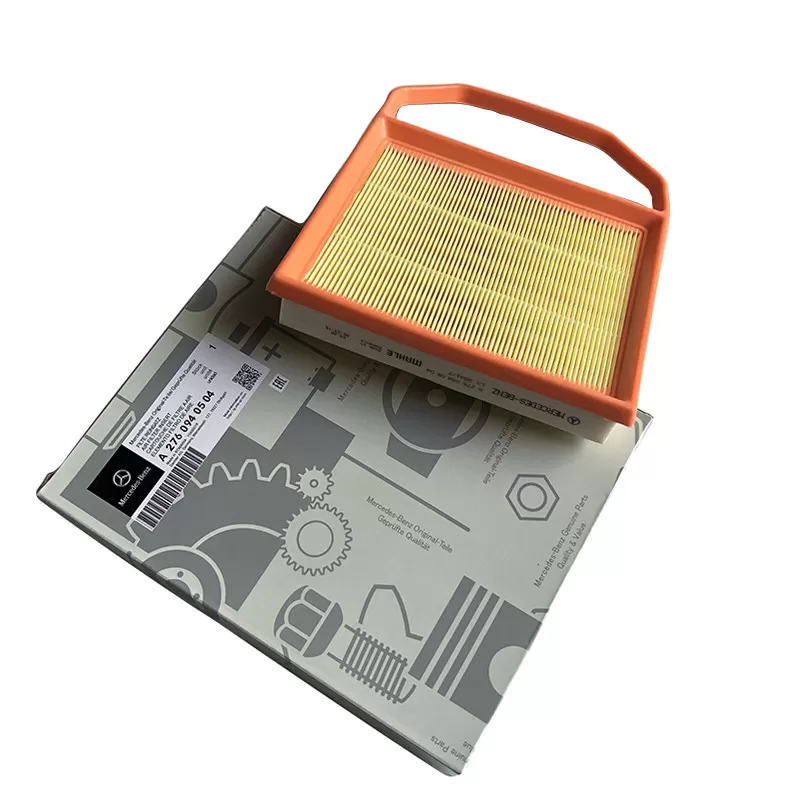
The filter is a pleated paper element in a plastic airbox between the intake duct and the mass airflow (MAF) sensor, stopping dust, sand and insects before they reach the sensor and the cylinders. As the pleats load up, resistance rises. The engine control unit fuels for the air that arrives, so a dirty filter does not make a modern Mercedes run rich; it starves it at high load. Peak power drops and economy slips because the throttle sits wider open for the same speed. Left long enough, the element tears or stops sealing and grit passes straight through, scoring bores, contaminating the oil and fouling the MAF sensor.
02 How often should a Mercedes air filter be replaced?
There is no single interval: Mercedes-Benz sets it by engine and model year, and the service booklet or service display is the reference. As a rule of thumb the element is commonly changed every 20,000 to 40,000 kilometres or as the service schedule specifies; treat that as typical rather than a fact about your car. Australian driving tends to shorten it:
- Dust — gravel roads, roadworks and outback trips. A week on dirt can load a filter that would otherwise have lasted a year; if the car sees dirt regularly, halve the interval.
- Coastal air, smoke and pollen — salt aerosol and humidity leave the paper damp and soft so it restricts flow sooner, and bushfire smoke and spring pollen add fine particulate on top.
So inspect the element at every oil change; with a new oil filter such as a MANN-Filter HU 8012z or Hengst E818H D238 going in anyway, the bonnet is already up.
Hold the element up to daylight. If light no longer shows through most of the pleats, dust falls out when you tap it, or the sealing lip is cracked or hard, replace it.
03 Where is the air filter on a Mercedes?
The airbox is a black plastic box with a duct on each side: one from a snorkel behind the grille or front guard, the other to the MAF sensor and throttle body. Its position follows the engine rather than the badge, and the owner's manual has a diagram. In general terms:
- Four-cylinder engines — on most recent four-cylinder Mercedes engines the airbox sits on top of the engine and the plastic engine cover is its lid; the A-Class, B-Class, CLA and GLA are typical. Many diesels and some C-Class and E-Class variants have the box to one side of the bay instead.
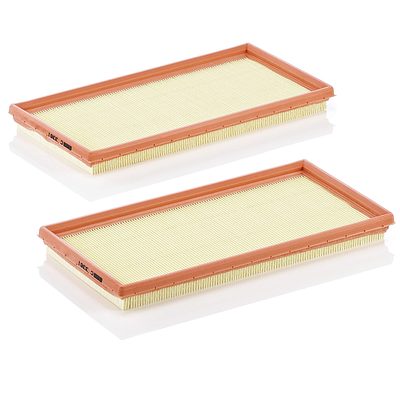
- V6 and V8 engines — many use two airboxes, one per cylinder bank, each with its own element, so the service needs two filters; check the quantity in the fitment table.
04 Step-by-step Mercedes air filter replacement
Tools: a Torx driver set, a flat-blade screwdriver, a torch, a vacuum cleaner and a clean rag. Engine cold and off; photograph the airbox before you undo anything.
- Step 1: Remove the lid — undo the screws or release the clips; many Mercedes lids hinge at one end, so swing the lid up rather than pulling it straight off.
- Step 2: Lift out the old element — note which way the sealing lip and any moulded arrow face, then lift it straight up so the dirt stays on the filter.
- Step 3: Clean the housing — stuff the rag into the outlet duct so nothing reaches the MAF sensor, then vacuum the box and wipe it with a damp cloth.
- Step 4: Compare and seat the new filter — same outline, pleat depth and seal profile as the old one, or stop and check it against the vehicle selector. Fit it the same way round with the sealing lip pressed fully into its groove.
- Step 5: Refit and check — tighten the screws evenly and stop when they seat, since the threads are plastic; start the engine, listen for a hiss at the joints, and note the kilometres in the service book.
If the cover will not release the way the manual describes, hand the job to a qualified mechanic rather than forcing it; the tabs break when levered from the wrong end.
05 Engine air filter vs cabin (pollen) filter
Owners regularly buy one expecting the other. The engine filter feeds the engine. The cabin filter, or pollen filter, cleans the air the heating and air-conditioning blows into the interior, and sits behind the glovebox, under the dashboard or in the plenum below the windscreen depending on the model; a weak fan and a musty smell are its symptoms.
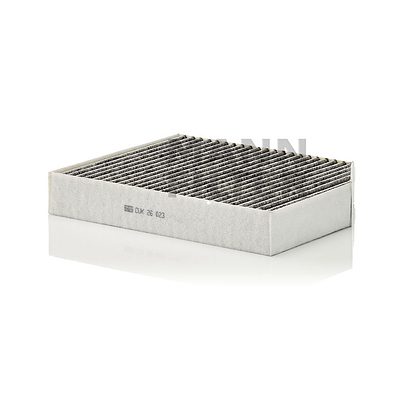
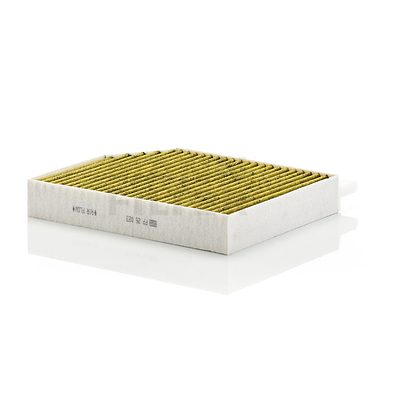
Both see the same dust and pollen, so do both at the same service. In the cabin filter range the choice is media rather than size: the MANN-Filter CUK 26 023 carries an activated carbon layer that also holds back exhaust odours, while the FP 26 023 is MANN-Filter's higher-specification FreciousPlus element in the same size; the shared 26 023 means same fit, different media.
06 MANN air filters and how to read the part number
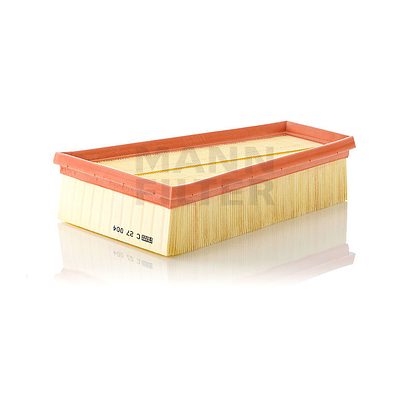
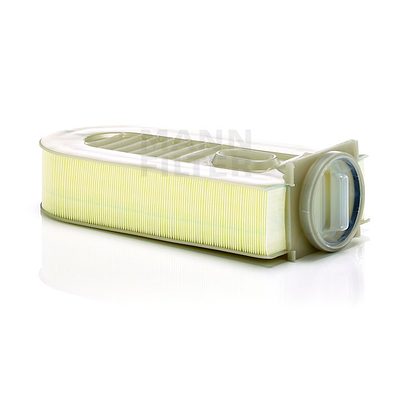
MANN-Filter is the aftermarket brand of MANN+HUMMEL, a filtration group that supplies European manufacturers as original equipment, so the boxed MANN-Filter element is the OE-equivalent choice for a Mercedes. Our engine air filter range includes the MANN-Filter C 27 004, C 35 005 and C 3361-2, each listed against the variants it is confirmed to fit. The part numbers follow a pattern:
| Prefix | Filter type | Examples we stock |
|---|---|---|
| C | Engine air filter | C 27 004, C 35 005, C 3361-2 |
| CU / CUK | Cabin filter; CUK adds an activated carbon layer | CUK 26 023 |
| FP | Cabin filter, FreciousPlus line | FP 26 023 |
| HU | Oil filter element (cartridge) | HU 8012z, HU 7025z |
The letters give the type, the digits are MANN-Filter's catalogue number for that size and shape of element, and a suffix such as -2 or /1 marks a variant; on oil elements a trailing z generally means the seals are in the box. Match the full number, suffix included, or match the OE reference on the product page against the number moulded into your old filter.
07 Confirming the right filter with the vehicle selector
Mercedes-Benz used several air filter shapes within one model generation, because the filter follows the engine rather than the body. Every category and product page here has a vehicle selector: choose make, model and variant and the page filters to parts with TecDoc-confirmed fitment for Australian-market cars, with a fits-your-vehicle confirmation and compatible-vehicle table on the product page. The Mercedes-Benz parts hub covers the rest of the service. Most of the Mercedes-Benz owner guides by model list the oil and coolant details recorded for the version they cover, and many also give a service checklist.
Check the fits-your-vehicle confirmation, the quantity (two for most V6 and V8 engines) and, if you still have it, the OE number on the old filter. If your variant is not listed, contact us with the chassis number and we will confirm the part before it ships.
FAQ Common questions
How often should a Mercedes engine air filter be replaced?
Follow the schedule in your owner's manual or the car's service display, because the interval varies by engine and model year; as a typical range, the element is commonly changed every 20,000 to 40,000 kilometres. On Australian roads, inspect it at every oil change and replace it once light no longer passes through the pleats.
Where is the air filter on a Mercedes A-Class?
On most recent four-cylinder A-Class models the air filter sits directly under the plastic engine cover, which doubles as the airbox lid: release the cover as the owner's manual describes, usually a few Torx screws or rubber grommets, and the panel element is underneath. Some older generations and diesel variants house it in a separate box to one side of the bay.
Can I clean and reuse an engine air filter?
Not a paper element. Washing softens and distorts the media, and compressed air opens holes you cannot see. Tapping loose dust off is fine, but once light no longer passes through most of the pleats the filter has done its job; against the cost of a mass airflow sensor, cleaning is a false economy.
Is a MANN air filter as good as the genuine Mercedes filter?
MANN-Filter is the aftermarket brand of MANN+HUMMEL, an original-equipment filtration supplier to European manufacturers, and its filters are sold as OE-equivalent parts matched to the Mercedes OE reference: the same type of media, seal design and fit in a MANN-Filter box. Confirm fitment with the vehicle selector and the number on your old filter.