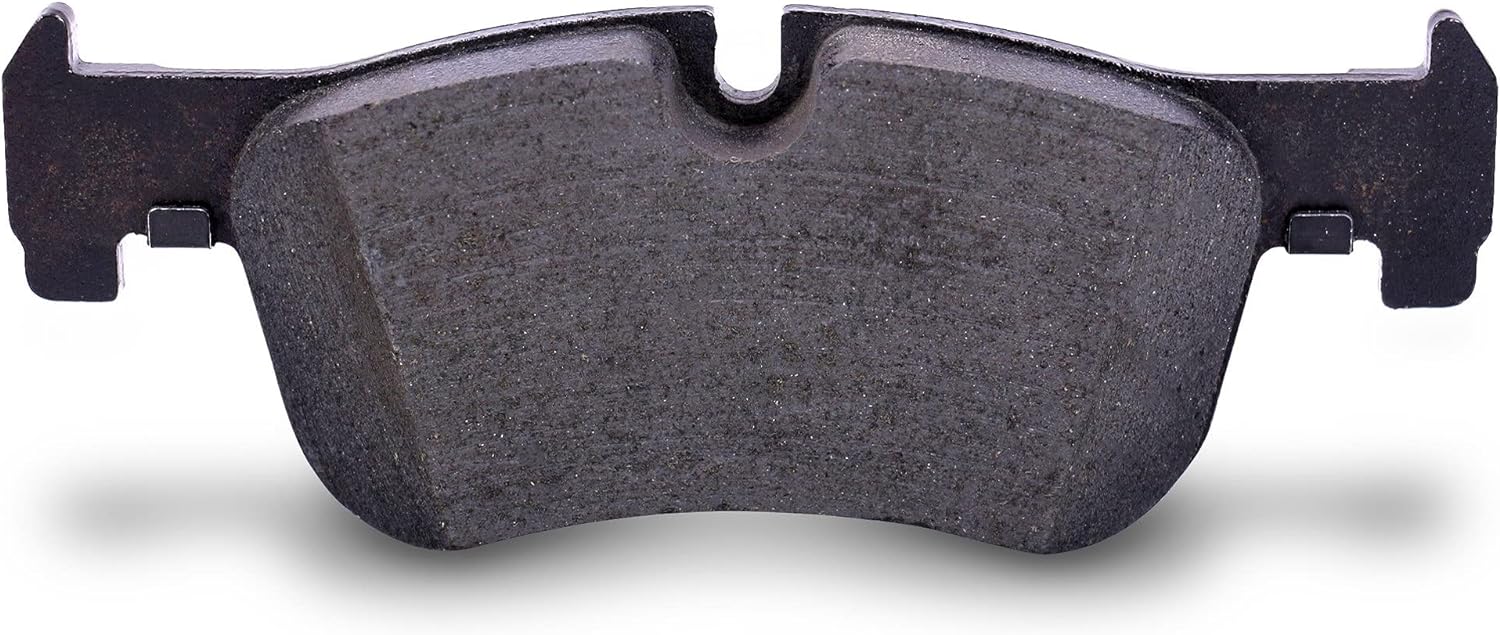
Brake pads and brake discs (rotors) wear as a pair, so a Mercedes-Benz brake replacement is normally a matched job done per axle rather than pads alone. Here is how the two wear together, the signs a set is due, what the job involves, what drives the cost of Mercedes brake pads and discs, and how to confirm the right parts.
01 How pads and rotors wear together
A pad is friction material on a steel backing plate; a rotor is a cast-iron disc bolted to the hub. Every stop scrubs material off both, the pad far faster, but the rotor thins too and unevenly: the swept face wears while the outer rim does not, leaving the familiar lip on an old rotor.
Mercedes-Benz specifies pad compounds that bite hard and stay consistent when hot, and rotor life pays for it: on many models the rotors are at or near their stamped minimum thickness by the time the second set of pads is due, and on hard-driven cars it can be the first. At the minimum the rotor is finished.
New pads on a worn rotor bed into a grooved, dished face: contact is partial, the pads wear fast and unevenly, and the thin rotor absorbs less heat, so judder follows. That is why pads, rotors and wear sensor are replaced together.
02 Signs it is time for new pads and rotors
One of these signs warrants an inspection; two means the job is due.
- Squeal or scrape — often the wear indicator touching the rotor, though dust and glazed pads squeal too. A scrape that rises with road speed means a pad is down to its backing plate.
- Grinding — metal on metal. The friction material is gone and the backing plate is machining the rotor; stop driving on it.
- Judder — a shudder through the pedal and steering wheel means thickness variation in the front rotors; through the seat, the rears.
- The dashboard warning — a sensor in one pad wears through and the car shows a brake wear message. How much pad remains varies, so have it inspected promptly rather than driving on.
- A lip on the rotor edge — run a fingernail from the outer edge inwards; a distinct ridge means the face has worn well below its original surface and should be measured against the minimum.
03 What a full front or rear brake job involves
Brakes are replaced per axle, never one corner. One axle needs the following.
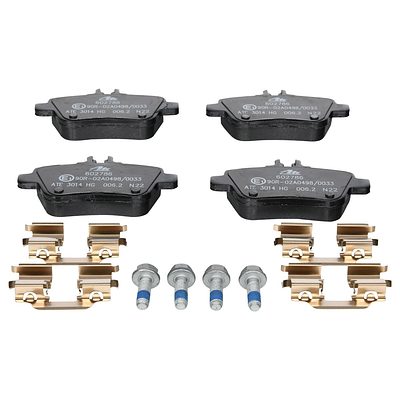
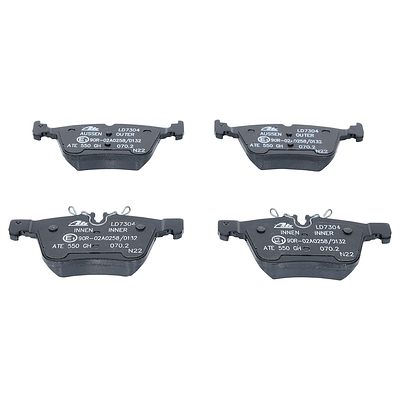
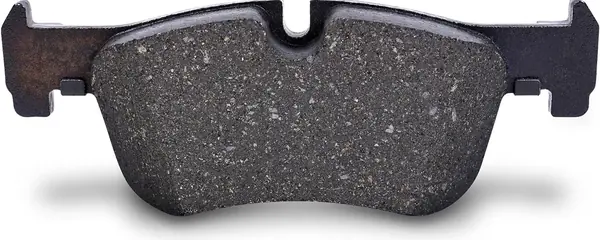
- Brake pads — one set covers both wheels.
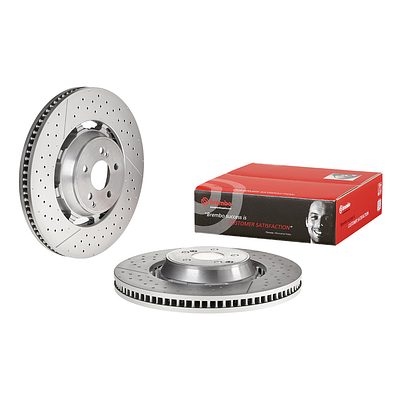
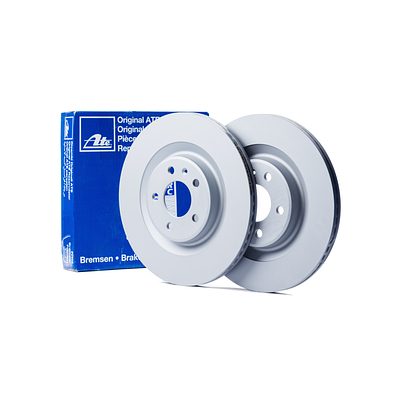
- Rotors — a pair; a Set (2 pcs) here is one axle. Some sizes are listed as left- and right-hand singles, so order both.
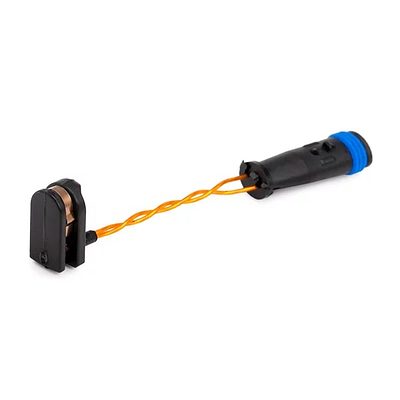
- Wear sensor — usually one per axle at a single wheel; single-use, replaced with the pads.
- Brake fluid — retracting the pistons raises the reservoir level, so fluid may need drawing off. If a change is due, do it now with the grade in the owner's manual.
- Grease on the contact points — brake lubricant on the pad backing-plate ears and caliper slide pins, anti-seize paste on the hub face, nothing on the friction face.
At each wheel the caliper hangs on a hook, never by the hose; the hub face is cleaned to bare metal before the new rotor goes on; and every bolt is torqued to the workshop manual figure.
With the pistons pushed back, the first pedal stroke goes almost to the floor. Pump it with the engine off until firm before the car moves.
04 Parts checklist for a Mercedes brake replacement
Everything is stocked under brakes, with prices on each product page. The examples show the ranges, not fitment; confirm your car in the vehicle selector first.
| Item | Per axle | Examples |
|---|---|---|
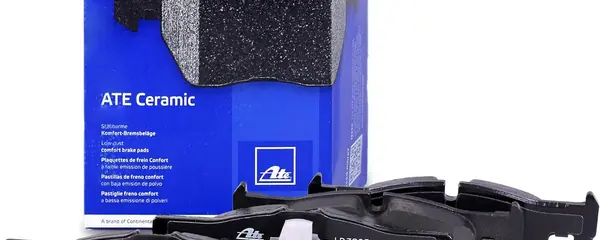
| Brake pads | 1 set | ATE 13.0460-2786.2, ATE Ceramic 13.0470-7304.2 |
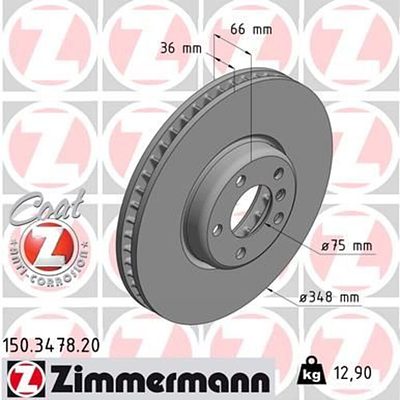
| Brake discs (rotors) | 1 pair | Zimmermann 310mm (2 pcs), Brembo 09.B848.33 (2 pcs), ATE 24.0124-0301.2 (2 pcs); singles such as Zimmermann 348mm Front LH |
| Wear sensor | Usually 1 | ATE 24.8190-0425.2, ATE 24.8190-0410.2 |
| Brake fluid | As required | ATE TYP 200 DOT 4, ATE SUPER DOT 5.1 |
| Brake grease | 1 tube | ATE Plastilube, Brembo B-Quiet; Mercedes-Benz Gleitpaste for the hub face |
ATE standard pads are the conventional OE-type compound; ATE Ceramic is built to cut the dust and noise conventional pads produce. The trade-offs are in the ATE Ceramic guide.
05 What affects the cost of Mercedes brake pads and discs
There is no one answer to what Mercedes brake pads and discs cost. Every product page shows its price; what the whole job comes to depends on five things.
- Part quality — OE-supplier brands such as ATE, Zimmermann and Brembo cost more than budget parts: you pay for consistent castings, balanced and coated rotors, and friction material that behaves the same hot as cold.
- Front versus rear — the fronts do most of the stopping, so front rotors and pads are larger, wear faster and cost more.
- Rotor size and AMG packages — AMG cars run larger rotors, some drilled or two-piece, with bigger pads, and prices scale with them. Rotor pairs are heavy, so delivery is priced by weight; the estimator on each product page shows options for your postcode.
- Extras — sensor, grease and fluid are small items that add up.
- Labour — set by the workshop and quoted per axle; we do not quote it. Ask for an itemised quote and compare the parts line with prices here.
06 DIY or workshop?
A Mercedes brake pad replacement with rotors is within reach of a competent home mechanic who has done brakes before, with a trolley jack and stands, a torque wrench, a piston retraction tool and a workshop manual. Use a workshop if the car has an electric parking brake and you have no diagnostic tool, if bolts are seized, if a piston will not retract cleanly, or if the fluid is due and you cannot bleed the system properly.
Brakes are safety-critical. Follow the owner's manual and workshop manual for your model, use the specified torque settings, and have the work done or checked by a qualified mechanic if anything is unclear.
Bedding in new pads and rotors
New pads and rotors need bedding in to lay an even film of friction material on the rotor. Follow any instructions in the pad box; otherwise make a series of moderate stops from suburban speed to walking pace without halting, with cooling distance between each, then drive gently for the first few hundred kilometres. Avoid hard stops, and do not hold the pedal hard at a standstill while the brakes are hot, which can imprint pad material.
07 Confirming the right parts with the vehicle selector
One Mercedes-Benz model can have several rotor diameters and pad shapes depending on engine, year and options, so a part that looks right will not necessarily bolt on. Use the vehicle selector on any category or product page: choose make, model and variant, and the listing filters to parts with TecDoc-confirmed fitment for Australian-market cars; each product page then shows a fits-your-vehicle confirmation and a compatible-vehicle table. Check front or rear, and left or right for singles. If the variant is ambiguous, send the VIN via the contact page. The full range is on the Mercedes-Benz parts hub; more guides are under resources.
FAQ Common questions
How much do Mercedes-Benz brake pads and discs cost?
Parts prices depend on the axle, the rotor diameter your car was built with, AMG specification and the brand tier you choose; each product page shows its price. Labour is set by the workshop and quoted per axle, so ask for an itemised quote that separates parts from labour.
Do I have to replace the rotors when I change the pads?
Not always, but on Mercedes-Benz models it is the norm: rotors often reach their stamped minimum by the second set of pads, and new pads on a grooved or lipped rotor wear unevenly and invite judder. Have them measured; if at or near minimum, scored or juddering, replace the pair.
Can I replace only the front brakes on my Mercedes?
Yes. Brakes are replaced per axle, and the fronts usually wear faster because they do most of the stopping, so doing the front rotors, pads and sensor while the rears still have material is normal. Never replace one wheel only, or pair a new rotor with a worn one.
Do I need a new brake pad wear sensor every time?
If the warning has come on, yes: the sensor is a single-use contact and the pad has worn through it. If the pads are replaced early and the sensor is intact it can be reused, but it is cheap and easily damaged on removal, so most workshops fit a new one regardless.